Zimbabwe is a land-locked country in southern Africa. It is a little bit larger than the state of Montana.
We are here to see Victoria Falls, one of the Seven Wonders of the Natural World.
Flying in you could see the cloud of mist marking the falls on the landscape.
Our accommodations here were quite nice, the five star Victoria Falls Hotel.
Originally constructed in 1904, they have maintained all the glamour and elegance of the era. We felt like gentry walking about the grounds.
Guards patrolling the grounds for stray wildlife did not carry spears here.
As with all places we have stayed in Africa they have directed guests not to leave their windows open lest monkeys will invade your room. These guests will have a surprise when they get back to their room.
Entrance to the falls.
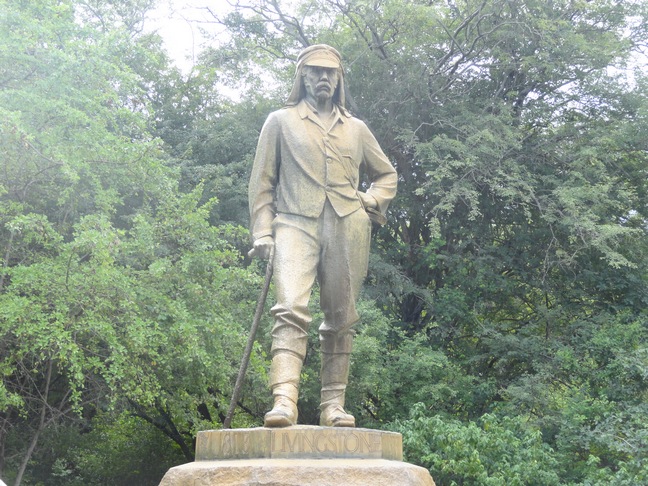
The falls were "discovered" by David Livingston in 1855. He named the falls in honor of Queen Victoria. The indigenous name, Mosi-oa-Tunya, literally means "the smoke that thunders".
The falls are created as the Zambezi River drops 351 feet into a gorge. The 5,698 feet wide falls can be viewed from the opposite side of the gorge.
While it is neither the highest nor widest falls in the world it is claimed to be the largest.
There is a drastic difference in the amount of water flowing over the falls during wet and dry seasons.
We are here during the wet season when the flow is at full volume and the mist is the heaviest, often obscuring views of the falls completely.
As wind directions shifted and the mist cleared we were able to catch momentary glimpses of the falls.
Caught this nice rainbow emerging from the falls.
This is "Danger Point". Did I go out for a look?
View from "Danger Point"
The Victoria Falls Bridge, constructed in 1905, spans the Zambezi River just below the falls and links Zimbabwe and Zambia
Zambezi River flowing through the Victoria Falls Gorge just below the falls with the Victoria Falls bridge in the left back ground.
We visited a local elementary school.
Over 2,000 kids attend the school. The day is broken into two sessions morning and afternoon. Half of the students attend the morning session with the other half attending the afternoon session. They then alternate sessions every other day. The average class size is 45 students.
Namibia is located in the south southwest of Africa. It is about the size of Texas and Louisiana combined, but only has a population of about 2 million. It is one of the least densely populated countries in the world. The country has suffered heavily from the effects of HIV/AIDS.
There is a thin piece of Namibia, referred to as the Caprivi Strip, that extends from the main body of the country at the northeast corner across the top of Botswana over to the "four corners" area where Namibia, Botswana, Zambia and Zimbabwe meet. Near the eastern point of the Caprivi Strip is a small island in the Chobe River called, Impalila Island. We visited a local village on the island during our stay in Botswana.
It is rainy season and the Chobe River was running full.
We hiked about a mile inland to reach the village.
The village children came out to greet us.
In the center of the village was a huge Baobab tree. It is estimated to be about 3,000 years old. The baobab is regarded as the largest succulent plant in the world.
The fruits from the baobab tree are used the make Cream of Tartar.
As with most villages in Africa, living conditions were rather minimal. This was the village chief's house, located behind a tall reed wall.
Each family within the village would have their house enclosed behind a reed fence. But the Chief had the largest enclosed area. Houses without a fenced enclosure were those of single individuals or young couples.
Inside a family enclosure.
Houses are constructed by first building a framework from tree limbs.
Then mud is placed between the framework.
A smooth outer surfacing of mud is than spread on the outside to finish the walls.
The village grows its own vegetables.
They get meat from chickens, goats, cows and fish. This little structure is a chicken house.
This one is for goats.
The villagers were selling hand-made crafts to make some money.
We bought the bowl in the second row, 5th from the left.
If you ever think you have it rough...come back and look at these photos.